News reports are filled with the Obama administration trying to do damage control. The primary reason cited is voters' wake-up call to Democrats following Republican Scott Brown's win of the senate seat vacated by the late Sen. Kennedy. This is also politically significant in that Democrats needed a minimum of 60 votes to pass measures. Now they're down to 59.
One item of good news emerges for caregivers according to an AP article this morning:
$100 million to assist families caring for aging relatives by providing help with transportation, adult day care and in-home aids.
This would help A LOT given the degree to which families' savings have been pummeled lately. I've been blogging about the State of California needing to do the same thing despite the rising deficit. Supporting and investing in families who care for loved ones is a wise long-term investment that will guard against even greater government expenses down the line.
As Americans ride a wave of uncertainty once more, Wall Street has been hit hard these last several days, with the Dow dropping nearly 500 points. If you own money market or mutual funds or even invest in the stock market, you are vested in the outcome of Wall Street's performance.
For the interim, watch Obama's State of the Union Address Wed at 9pm ET/6pm PT.
UPDATE: TheCaregiversVoice.com upgrade
As with any worthy endeavor, things often end up taking longer than planned. We've been working diligently on the newly upgraded website for The Caregiver's Voice and are still planning a major launch event in Spring (date TBD-likely late April), while still aiming for a "sneak preview" in early February. We'll keep you posted!
HAPPY NEW YEAR!
One full week of 2010 has passed...how have these initial days of your new year been going?
My wish is that you remain filled with hope because the truth is what other option do you have?
If you choose to grow sad and lose hope, your caregiving journey will grow even more difficult amidst the darkness.
Look for the small joys; sometimes, they're really tiny and you have to look really hard. But once you find them you rediscover your smile and moments of happiness begin to fill your heart and your loved one can feel it in your actions. All of a sudden you find caregiving not as challenging. TRY IT, then write to me at BrendaAvadian@TheCaregiversVoice.com.
2 UPDATES
THE CAREGIVER'S VOICE WEBSITE UPGRADE
We are still on schedule for our Spring launch of the newly revised and upgraded TheCaregiversVoice.com, designed with you in mind--to serve more of your needs at one location.
Until then, we'll have a "sneak preview" of the new site at the earliest in late January or, the latest, by early February.
We'd love to have your comments!
FINDING THE JOY IN ALZHEIMERS on Ebay for $85.31!
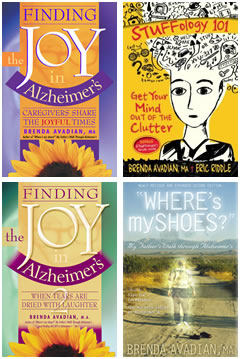
We couldn't believe it when we saw this, but the first volume of our Finding the JOY series: Finding the Joy in Alzheimer's: Caregivers Share the JOYFUL Times was priced on eBay for this astronomical figure. Check it out here. Then again, we only have ten copies of the initial (2001) print run. The updated 2006 edition is the one that is availabe now. You can find it for only $14.95 here.
I hope you are having a delightful time with your family and friends during these holidays!
Sometimes I believe the reason we have holidays are to have the opportunity to shift gears and focus on the people who are important in our lives. Otherwise, we'd just continue working, working, working. And where's the good in that?
There are only three days left before the New Year.
My wish for you is a WONDERFUL 2010! May this be the year that brings you greater health, happiness, (and some recovery in your finances).
We, at The Caregiver's Voice, have an exciting New Year planned with the Spring launch of our completely upgraded website to better serve you the family and professional caregiver.
For more information, please click on the following articles:
TheCaregiversVoice.com: Newly Updated and Fully Interactive Site to Launch in 2010 How do we balance responsibilities while taking care of ourselves?
TheCaregiversVoice.com: Newly Updated and Fully Interactive Site to Launch in 2010
We look forward to working with you in 2010!
Brenda Avadian, MA Founder, TheCaregiversVoice.com
TheCaregiversVoice.com undergoing a major transformation. The new site which helps family caregivers of adults with brain impairment and professionals will be formally launched late January 2010.
For more information, please click on TheCaregiversVoice.com--Newly Updated and Fully Interactive--to launch in Jan. 2010
Brenda Avadian, MA TheCaregiversVoice.com
When an occupational therapist sometimes moves an Alzheimer's patient's arm or massages a certain spot, memories will flow. What if years of stress leading to mental illness and emotional problems can also lead to Alzheimer’s?
Occupational therapist and acupuncturist, Deborah Barham, spent sixteen years observing and compiling her conclusions. Although advances in the cause and cure of Alzheimer’s are expected from researchers and neurologists, how often has a detail found via an unconventional channel, lead to a breakthrough? We’ve read of researchers making a major discovery while searching for something else. The discovery of penicillin is one example.
Barham’s work addressing stress and the body’s emotional memory might add that one component to an open-minded researcher’s work that may give us a clue to advance the science of this devastating disease.
After all, it doesn’t take much for us to realize that our world is growing increasingly complex and stressful at the same time. While we have gadgets to buy us more leisure time; instead of washing clothes by hand at the side of the river, we now use the time to reply to stay connected online, keep up with more information in one-hundred years than all the time humanity has existed on earth!
For more information read the article at the Hickory Record.
Brenda Avadian, MA
Founder, TheCaregiversVoice.com
The NUMBER ONE tip for stressed out and overwhelmed caregivers of brain- impaired adults (e.g., Alzheimer’s) is to take a FIVE-MINUTE RESPITE.
Most of us feel so busy in this rush-rush world, a five or ten minute respite seems doable.
Things to do during your FIVE-MINUTE RESPITE…
Step away momentarily from the cause of stress.
Go outside: breathe the air; enjoy the view, take a few steps.
Go to another room and stretch. Be sure to breathe deeply.
View a fun and/or inspiring video online (e.g., You Tube).
Listen to a piece of your favorite music that energizes and gives you hope.
Remember, if you don’t take a few moments to de-stress,
you may like suffer from long term distress.
More caregiving tips are available in “Where's my shoes?" My Father's Walk Through Alzheimer’s.
Tenth Anniversary HOLIDAY special
FAMILY CAREGIVERS
Get your caregiving friends together or your support group and buy a case of 20 books for gift giving this season. Give your family and friends the gift of understanding.
Retail with tax and shipping: $393 or $19.65 copy
YOUR PRICE: $249 or $12.45 per copy (We’ll pay shipping and tax)
PROFESSIONALS
Families need to know their care options—whether in-home care combined with adult day care, assisted living, or nursing care. Offer your clients a lasting and personal gift that will be passed from family to friend at least 3 times given the feedback we receive from our readers. Same pricing as above. If you’ve already spent your budget allotment this year and will receive funding in January, let us know now; to receive an extension on this special holiday offer.
For more about the book, see “Where's my shoes?" My Father's Walk Through Alzheimer’s.
To take advantage of this special, send us an eMail now, and we'll take care of the rest!
At Everbetter.ca/health an informative and Canadian-based website, Laurie Pawlik-Klienlen offers us Understanding the costs of care providers. Regardless of where you live, there is something to be learned from other countries’ practices.
Laurie recently interviewed me. Below are three points that didn’t make it into the article:
November marks three celebrations for caregivers of loved ones—
National Family Caregivers Month,
National Alzheimer’s Disease Awareness Month, and
Thanksgiving.
An inspirational story of gratitude is posted at:
A Touching Story of Gratitude Rising from the FLAMES The Amazing Power of Gratitude despite loss touches us during this season of Thanksgiving.
It’s time to reprise a timeless piece. If you find yourself standing helplessly wondering what you can do to help the caregiver in your life, this article offers you three tips. Be sure to share this link with your family and friends.
A Time for THANKSGIVING: for Caregivers across America3 Ways to Give Thanks to a Caregiver this holiday season
After embarking upon the caregiving journey, many find that it is fraught with far greater responsibilities than they imagined. Setting aside their own needs, they tend to loved ones with compassion. When the caregiving journey finally ends, many find themselves too ill to live a quality life they deserve.
Michelle Bersell, a fellow University of Wisconsin-Milwaukee, alumna, wrote, How High Is Your Pain Tolerance When It Comes to Stress?
Caregivers know A LOT about stress. While reading her illuminating article, I experienced two opposing reactions. Please read her article here and then return to this blog to read my reaction.
One, now that you've given us permission not to tolerate pain so well, we'll suffer with a bunch of whiners!
Two, what an eye-opening piece for overwhelmed people. To avoid the first reaction (above), we all need to use appropriate communication skills to tactfully express our pain.
Let say, for example, you've been feeling a recurring but tolerable pain in one area of your head. You mention it to your doctor. S/He says it's really nothing. You let it pass until the next appointment. But you forget to mention it. A year later, you remember to mention the pain because it hurts more. The doctor tries to pass it off again. This time, you hold your ground. Gently, you emphasize that you neglected to mention it six months earlier and that you have a strong feeling it needs to be looked at. You explain that patients are often better at catching issues with their own bodies than doctors are. You add that you've been the kind of patient that usually waits too long, anyway.
Your doctor agrees with your last point and refers you to a pain specialist. The specialist refers you to a neurologist. The neurologist conducts a few tests and then orders a scan. The scan shows an area of your brain that causes concern. The neurologist believes you are at risk for having a stroke.
Bersell reminds us to be aware of our bodies, our relationships ... our lives. Let us take heed; otherwise, the consequences may be too much too bear...and NO WHINING!
Thank you, Michelle.
I met Rebecca Colmer online almost two years ago when she asked me to review the Family Caregiver Starter Guide. I did and then gifted it to a caregiver during one of my keynotes. At the same time, Rebecca sent me a series of other books she had written with Todd Thomas and I promised to review them. It's been nearly two years. (I'm sorry, Rebecca!) But the information holds true today as it did two years earlier. Please find my review below.
The Senior’s Guide to the Internet: Surfing, Shopping, E-Mail and Security
By Rebecca Sharp Colmer and Todd M. Thomas, 2007
Colmer and Thomas have written a series called The Senior’s Guide on a diversity of topics.
This guide to the Internet offers a wealth of information for those who have not yet learned to use the Internet or go online so seldom that a book like this provides a handy reference.
Organized in ten easy-to-digest chunks, I recommend those new to the Internet read one section at a time.
After being online for fifteen years, even I learned a few things such as groups.google.com, mirc.com (for live internet discussions), and usage and population statistics available at InternetWorldStats.com.
The Internet is like driving a car. Most of us really don’t know how it works, but we use it. Colmer and Thomas give us a peak under the hood with their brief overview of varied topics such as TCP/IP and SMTP and HTTP.
They also remind us to be careful when downloading files or opening links. In fact, they suggest manually typing a link instead of clicking on it; especially, from uncertain sources. They claim that some links may contain spyware, which is unknowingly transferred to our computer, wrecking all sorts of havoc from harming our files or recording keystrokes. Current security software as those provided by Norton or McAfee will scan your computer and eliminate such threats.
Initially written in 2005 then updated in 2007, there are a few dated items, such as the mention of WebTV which is now MSNTV, but these dated items are minor compared to the value of the information provided. The book concludes with 25 tips to using the Internet.
The books are published in large type and are easy to read even without reading glasses.
For more information visit TheSeniorsGuide.com
Reviewed by Brenda Avadian, MA
Other titles in the series are:
According to today's advertisement on Help A Reporter Out (HARO) provided by Peter Shankman, top-level domains (like .com) will be available for branding in 2010.
This means instead of TheCaregiversVoice.COM you'd be visiting TheCaregiversVoice.AVADIAN.
How cool is that?
Then again, what implications will this have for those named Smith or Jones in the U.S. or Wang in Taiwan, or ...
Start thinking about your brand and how you'll promote yourself. Think of all the branded products (Kleenex, Coke) or companies (Google).
The potential of the Internet is still in its infancy.
Pioneers who continue crafting such creative initiatives (like FaceBook and YouTube) are shrinking the global communication channel. Soon, borders will be irrelevant and a thing of the past as the human race becomes one.
But, before all that happens, we'll have to stay tuned. There are a lot of exciting things ahead.
On this, the ten-year anniversary of the initial publication of “Where’s my shoes?” My Father’s Walk through Alzheimer’s, I reflect on an eMail my husband sent to me about my father. This was less than a year before we were to become caregivers. (We called my father by his first name, Mardig, which means Martin in Armenian, and is pronounced MAR-deeg.)
While I was in California, my husband was staying with his brother and sister-in-law in Wisconsin. Between his work and free time David juggled caring for my father who still lived in his own home of forty five years. He sent me the following e-mail:
Dear Brenda,
I am at work and I am thinking about your father. I really think that he will soon be near the point where he will no longer be able to take care of himself. I don’t think your sister or brother realizes this. Mardig doesn’t talk much to them, and they really don’t deal much with his day-to-day existence.
The more I think about it, I am sure your father lost about $600 this week, or it could have easily been stolen without him realizing it. It worries me somewhat that with winter coming, he may start a fire in the basement using the incinerator. He is already stockpiling wood in the basement. I really don’t know why.
He really needs someone to spend time with him more and more. I know if something terrible happens to him because of his own actions, your brother and sister will wonder how he could have done something so stupid. I guess they don’t really talk to him long enough or have the patience to just listen to him speak. If they’d just let him think aloud without leading the conversation, they would see that he is impaired.
I don’t know what to do about this situation. I feel that I am in the middle. If I do something to try to help your father, your sister and brother will view it in a negative light because they truly see nothing wrong with him. They don’t have the patience or the time to have a normal conversation with him. It is not just his hearing; it’s his brain too.
I really feel he needs looking after, and I can only do so much. I was thinking of him all Saturday, Sunday, and today. It is a lot more serious than your brother and sister realize. He may end up killing himself or someone else. He really shouldn’t drive anymore. Sometimes he gets really confused and, one day, he may forget where he lives.
Sorry about this, I just needed to vent.
Love, David
Excerpt from “Where’s my shoes?” My Father’s Walk through Alzheimer’s, 2nd ed. 2005, Pearblossom: North Star Books. First edition released in 1999.
“It cannot be denied that Where’s my shoes? is a love story. On the surface it tells the true story in real time, as Brenda faces reality and makes hard, yet informed decisions. But between the lines, it’s about the youngest daughter taking responsibility for family affairs and the care of her beloved father.”
Mark Warner
Co-founder: www.alzstore.com
Author, The Complete Guide to Alzheimer’s-Proofing Your Home
Caregivers are often burdened by "stuff;" especially, the accumulations of those we care for. I've written about clearing out my parents' home of forty-five years of accumulations. They brought "stuff" into the house and rarely did anything come out. Like that television series, Hoarders, my husband, David, thinks my parents were compulsive about collecting and saving things.
Earlier this month, David and I got our own scare when the massive Station Fire was moving very close to our home. Faced with evacuation, we packed his SUV and my tiny convertible with a fraction of our treasures. I wrote about this for the monthly news column.
Debbie Center, former caregiver to her mom and joyful story contributor to the Finding the JOY in Alzheimer's series comments on one of these September news articles, entitled: FIRE! Quick! What really matters?
Fantastic articles, Brenda!!! You know, when we go to MN for the summer, we leave all of our shtuff here at the house. We have minimal clothing, and live in a cabin relatively free of clutter for nearly 3 months. The only thing I really miss is my piano, and I can go to a nearby church to play when the mood hits. I also brought a digital keyboard this summer, and that worked out fine.
Worldwide: 35 million
United States: 5.3 million
The numbers will continue to rise more dramatically as the world’s population ages.
When my father was diagnosed with “probable Alzheimer’s” in late 1996,the figures were 18 million and less than 4 million.
Today, with more accurate diagnoses, the Alzheimer’s Association estimates that one person is diagnosed with Alzheimer’s every 70 seconds. Given the pattern of these numbers (one second less each year); we can expect two people diagnosed per minute by mid-century.
During the next two months, Alzheimer’s Association offices across America will coordinate walks across the country to raise awareness and funds.
Until there’s a cure, three areas need our immediate attention. Two of these focus on family and professional caregivers and the third, on organizations at the front lines helping families:
During this nation’s hardest hit economic times, is when the greatest innovations have occurred. America’s caregivers perform heroic roles each day. As our aging population requires greater care, we need to take an honest look at dignified aging and the support needed for a continuum of care.
A thought-provoking series that overviews a breadth of topics of concern to baby boomers approaching retirement.
A nine-part series hosted by Paula Zahn addressing diverse topics of interest to retiring baby boomers, including (segment times in parentheses):
Eight of the nine segments range from about 8 to 13 minutes each.
Watch each segment online as your schedule allows or check PBS for your local broadcast schedule.
Refer segments of interest to others so they too may benefit.
http://www.pbs.org/wttw/retirementrevolution/watch/
This week, we've been distracted by the Station fire threatening our home. This fire, in the Angeles National Forest of southern California was reported to be one of the largest fires if not the largest, in recent history.
Whether you're threatened by floods, tornadoes, hurricanes, earthquakes, fires, or another life-threatening cause, it makes you stop and consider a lot of things you take for granted...
As caregivers, especially for the brain-impaired, we learn to take few things for granted and appreciate those moments we can share with loved ones.
For more insights from these fires, read this month's news column: FIRE! Quick! What really matters?
At the height of inflation in America, Anatomy of an Illness, Norman Cousins’ oft-cited book, achieved wide-ranging acceptance. Thirty years later, people still frequently refer to Cousins and how he cured himself.
If there’s one thing a graduate education taught me, was to go back to the source. Knowing that details change a little each time in the retelling of a story, I wanted to know:
What really happened?
What exactly was Cousins’ illness?
What exactly did he do to become cured?
Cousins, long-time editor for the Saturday Review, had traveled as chairman of a delegation to the Soviet Union in 1964. During the hot nights, he slept in a second floor hotel room with the windows wide open. Diesel trucks spewing fumes drove through the residential area they were staying each night. The days were stressful for Cousins filled with overwhelming responsibilities and pressure. He believes his already compromised immune system (due to stress) succumbed to the fumes.
He had a collagen-related illness (related to arthritis) where the connective cell tissue was breaking down causing him agonizing pain and near paralysis. His doctors gave him a 1 in 500 chance at full recovery.
Cousins partnered with his doctor. Being in a unique situation of having both a personal and professional relationship with his physician, Dr. Hitzig was open to discussing the ideas Cousins proposed for his recovery.
First, Cousins wondered if his stay in the hospital was unpleasant (noise and being woken for blood samples at all hours) and not conducive to recovery, what impact would positive experiences have? He also realized that the mega-doses of pain killers he was receiving (e.g., as many as twenty-six aspirin daily) were toxic; thus, hampering his body’s natural defenses. Recognizing his urgent need to recover and have a normal life, his doctor supported him on a “prescription” of watching funny films. Cousins found that ten minutes of belly laughter were as effective as the painkillers. Again, with his doctor’s consent, he stopped taking them.
After reading studies published in medical journals, Cousins was convinced that mega-doses of ascorbic acid (vitamin C) might be the cure. Instead of the 3 grams of intramuscular injections, he wanted to start at 10 grams, twenty times the typical 500 mg dose we take as a supplement. Since our bodies can only absorb so much, he discussed the idea with his doctor of an IV drip across 3-4 hours a day for one week. By the end of the seventh day, he had increased the dose to 25 grams.
Although, this bold treatment combined with laughter therapy didn’t cure Cousins, it laid the foundation for his eventual recovery.
Two other points bear mentioning.
One, he credits his success with the single-minded focus of desiring to get better and doing whatever it took to get better. He emphasizes mind over matter.
Two, he believes as do other medical personnel who he quotes, that time to dialog with patients, understand their concerns, and explain courses of treatment play a more significant role in healing than all the modern technology we’ve come to depend on. (This was thirty years ago!) One cardiologist recommended the physician being at the emergency room to greet the patient. Imagine that!
Albeit thirty years old, An Anatomy of an Illness, bears revisiting by patients and doctors alike. Meanwhile, we need to listen to today’s medical personnel, like Drs. Bernie Siegel and Peter Whitehouse, when they too emphasize the need for physician patient dialogue and understanding.
FREE from the Federal Trade Commission thanks to US tax dollars
WHO CARES addresses four areas: Care and Services—e.g., hiring caregivers; Pills and Products—e.g., buying Rx online; Scams and Frauds—e.g., Rx assistance programs; and How to File a Complaint.
The 20-page booklet is a helpful and easy-to-use resource devoting a page to each topic.
To view a copy online, this link that will take you directly there:
http://www.ftc.gov/bcp/edu/microsites/whocares/index.shtml
To order a hardcopy of the booklet using the FTC’s automated service, call toll free: 877-382-4357 or 877-FTC Help then press 4.
The FTC also offers
A Note to Homeowners
Tips of caution when seeking help with foreclosure
http://ftc.gov/MoneyMatters
AVOID Theft
Tips to Deter, Detect, and Defend against Identity Theft
http://ftc.gov/idtheft
Dear Family and Professional Caregivers,
If the summer is going by too quickly and you have not yet had your respite, why not look forward to a weekend vacation-retreat?
It’s no secret I’m a fan of carefully planned caregiver retreats. Such outings are key to being able to rejuvenate in order to continue providing care.
You deserve it and your loved one deserves quality care. So, do yourself and your loved one a favor and take a break.
If you’re a professional and are able to attend, imagine all that you can share with your clients! (Tell your employer, Brenda Avadian, recommends that you attend.)
If you’ve wanted to have a fun adventure in Colorado, here’s your chance!
Founder
TheCaregiversVoice.com
P.S. I’d love to go, but I will be making my first attempt at climbing Mt. Whitney in California’s High Sierras.
This three-day gathering (September 19-21) provides caregivers with a much-needed reprieve from their tremendous work each day.
Caregivers will learn about a myriad of adaptive sports activities, enjoy adventures with our professional guides, relax and rejuvenate, network with one another and gain valuable professional resources.
The height of the fall colors in Crested Butte will provide a stunning backdrop for this event.
Professional caregivers and parent/spouse caregivers are all invited.
$625/person with lodging and airport shuttle
$415/person without lodging and airport shuttle.
Includes: two days of activities: challenge course, a.m. hike, whitewater rafting, one dinner, two lunches, social evening, yoga/massage, activity transportation and guest speaker.
Adaptive Sports Center
Crested Butte, Colorado
Contact: info@adaptivesports.org
Toll Free: 866-349-2296
Website: www.adaptivesports.org
Has this been a busy summer for you, too?
I don’t know what it is, but 2009 has been very busy. I thought the summer would offer a reprieve, but NO.
When I ask others, they echo my sentiments.
What is happening? It seems, each time I may have a moment of time, it gets filled with something.
For more, please read this month's Ask the Caregivers Voice column.
With President Obama’s appointment of Chief of Staff Rahm Emanuel’s brother, Dr. Ezekiel Emanuel to key health care advisory positions, there’s increasing criticism and name calling.
We must step back (especially, since Congress will not likely arrive at healthcare legislation until after they return from recess) and consider America’s health care policy.
Like a tanker ship, it took us a long time to get where we are. We can’t turn on a dime. We need to whittle away at the elements that make for poor healthcare and address the issues we face, including:
Let’s look at each one of this briefly.
We need to return to the one-on-one care provided by the family care doctor who is best informed of the patient’s continuing health care needs. Rewarding physicians at this level will ensure patients receive quality care.
While we can’t change the demographics of our population, we can take a realistic look at end-of-life care and ensure families are made aware of the choices they can make for a dignified and peaceful passing; such as, no heroic measures. This is not to say that someone diagnosed with a dementing illness such as Alzheimer’s should not be given care. However, those of us at the tail end of the baby boom generation and younger, need to be realistic and take steps now to as we will likely fund much of our own care; especially, if we want care above and beyond what our government and insurers will provide in years to come.
We need to return to this level of conscientious saving. The government cannot continue bailing us out. Our government by its very size and need for procedures, operates inefficiently. (When was the last time you witnessed a government employee tell you: Oh, I understand your situation. Okay, for you, we’ll do it this way.) By its very nature, our government dehumanizes care by treating everyone in a given category the same. It does not consider your uniqueness.
Let us take time to digest what these times are like and to practice sound economic management in lieu of the quick fix for the quick buck. I know this is wishful thinking. As soon as times get better, it will be hard to break our old habits. But if we’re to be successful, we need to change.
Only after we address these four issues can we take constructive steps toward turning America’s tanker-sized health-care crisis in the right direction.
The responsibility does not rest in Obama’s, Emanuel’s, Congress’ hands alone. The responsibility is OURS—yours, mine, and our elected representatives. We need to do our part by saving and spending conscientiously, while making our policy makers vividly aware of the impact of their decisions. Only then, can our needs be met with sound policy.
Sometimes, we create our own families to fill the void we feel in our own. Such is the case with Gini and Ron, two family members I adopted nearly a decade ago through a mutual friend who was skilled at introducing strangers who fast became friends then family.
It was with bittersweet joy that I read Gini's eMail—bitter, because I was sad for the journey she and Ron must now take; and sweet, because they are now able to benefit from my experience.
With Gini's (and Ron’s) permission, here is her (slightly edited) eMail:
Little did I think when I asked about resources for my friend that we'd be needing them as well. Ron's mother has developed dementia -- whether it's AD or some other cause isn't known (she wears a pacemaker so cannot have an MRI) and in the final analysis isn't really relevant. But according to what we've been reading, she's well along -- definitely stage 4, possibly stage 5. And, like your dad, she suffers from sundowners, when she tends to take her frustrations out on family members, whether in person or by phone.She took a bad fall early last month, and by all rational evaluations should not have survived. A bad head gash (11 staples and 11 stitches to close), a night spent outside, and a Coumadin level of over 5. But, despite her history of spinal fractures and a pelvic crack, none of which seem to have been directly associated with the fall, she has recovered, at least physically.
We had been trying to coax her into considering either a senior apartment or assisted living situation for a couple years to no avail. We finally succeeded when we moved her into an assisted living facility that has a memory care unit (when this becomes necessary). And, interestingly, hydration has proven to have a significant impact on her cognitive state. Despite the fall and head wound, when they had her on IV fluids in the hospital, she was much more coherent. Within 24 hours of removing the IV, her cognitive function had significantly declined.Fortunately, I'd read your book, and it has been a great help in understanding both how to interact with her and what to expect in the future.
Thank you, Gini for taking the time to follow-up with your experience.
______________________________________
Gini refers to "Where’s my shoes?" My Father's Walk through Alzheimer's in her eMail. If you've had a positive experience with one of our books, please send us an eMail and let us know. We'll appreciate you for taking the time.
CARGIVING TITLES at the American Library Association Convention
While visiting family last week in the Milwaukee and Chicago areas, I snuck in a little business this past weekend by attending the American Library Association convention. (See July 6 blog for additional information.) I met with publishers to learn of any caregiving titles they offered. Sadly, I saw less than a handful on exhibit. Usually, library conferences cater to children’s titles. (At least, this has been my observation.) However, I was surprised to see a consortium of German and Spanish publishers and took some time to learn what caregiving and Alzheimer’s titles they offered. The well-organized German exhibit offered a computerized database with hundreds of titles, much to my pleasure. The representatives from Spain specialized in other areas; so I was not able to readily find titles of interest to caregivers. I am heartened that awareness continues to spread in Germany, at least.
Denise Brown of CAREGIVING.COM
Afterward, Chicago-area-based, Denise Brown of Caregiving.com and my husband, and I met at Chinatown for delicious Dim Sum (at Phoenix) and dessert (at Saint Anna). We talked for a couple hours about the state of caregiving advocacy and lamented the need for integration of efforts in order to present a stronger front; especially, during times of budget cuts. Denise observed that many caregivers try to reinvent the wheel instead of seeking existing resources. I commented on how, given my background in organization development, I witness too many organizations guilty of the NIH syndrome, which is usually expressed as: We’re not interested in anything Not Invented Here.
If we’re to succeed, we need to draw on the strengths we each have to offer. Divided we fall. United we are strong.
MSNBC Interview
By the time I returned home on Monday, I received confirmation of the publication of an interview I had with Diane Mapes of MSNBC about people who stash cash and then often forget about it.
Excerpt: Brenda Avadian, a 49-year-old caregiver advocate from Pearblossom, Calif., says “her heart stopped” when she found a packet of 30-year-old U.S. savings bonds shoved between two books while visiting her father.
For more, see: Money hiders risk a wealth of woes.
Reports show that more people are using libraries than before. With cash-strapped families trying to make ends meet, consumers are electing to visit their libraries to check out books, DVDs, and more.
In this aim, I’ll be visiting the American Library Association (ALA) convention in Chicago this Saturday to learn how many of our nation’s libraries are acquiring titles to help the millions of American families who provide care for a loved ones.
This is a two-way street. Effective librarians try to acquire titles their patrons are requesting. So if you and your fellow caregivers request informative materials to help you care for your loved one, your local librarian will likely try to carry more caregiving titles.
In this aim, I will try to promote our titles, for example,
"Where's my shoes?" My Father's Walk through Alzheimer's or
Finding the JOY in Alzheimer's: Caregivers Share the JOYful Times.
I will also walk the aisles and learn of titles offered by other publishers and if there are stellar standout titles, will review them in this blog in the coming months.
Recently, I was asked by a syndicated columnist to provide statistics on caregiving.
Number of Caregivers in the United States
Estimates vary as to the number of caregivers in the United States. The National Family Caregivers Association commissioned a study a few years back finding 56 million caregivers in the US or about 20% of the population.
I recall reading that about half of today’s caregivers work full or part time. To help in-home caregivers, there are about 800,000 home health aides according to Home Instead. If 20% of the US population provides care for someone, what do the worldwide figures look like?
Number of Caregivers Worldwide
Given the diversity of cultures, statistical figures are often extrapolated to account for lower reports of disease and illness (due to embarrassment--e.g., admitting a family member has Alzheimer’s) while balancing these figures with a higher percentage of families caring for loved ones at home in third world countries due to lack of care-resources such as assisted living or nursing homes. For example, 15 million orphaned children of AIDS in Africa are cared for by grandparents.
Worldwide, the extrapolated estimates approach 1.2 billion caregivers; again, about 20% of the world’s population.
Shortage of Caregivers …
As the Baby Boom generation ages, we’ll come head to head with a shortage of caregivers.
In China
Consider China’s population of single-child households who will begin turning eighty at the middle of this century. China has fewer nursing homes than most developed countries. Who will care for the aging Chinese as their children move to the cities for better opportunities?
In the United States
Consider the numbers of increasing numbers of people being diagnosed with Alzheimer’s disease. According to the Alzheimer's Association 2009 Alzheimer's Disease Facts and Figures report, one new person is diagnosed with Alzheimer’s every 70 seconds. Last year, it was every 71 seconds and the year before that, every 72 seconds. Given the trend, unless there’s a cure, next year, one new person will be diagnosed with Alzheimer’s every 69 seconds. By 2050 when the youngest Baby Boomers reach age 86, there will be a new diagnosis every 29 seconds or two a minute! That's an astounding 1.05 million diagnosed each year in the United States alone!
Escalating Costs of Care
Imagine the escalating costs during the next decade, when 9.9 million unpaid caregivers today are saddled with $148 billion in costs each year as they provide care for 5.3 million people with Alzheimer’s, the 6th leading cause of death.
Can Caregivers Survive Budget Cuts?
Be sure to visit the July News edition: Reducing Support for In-Home Caregivers will Dramatically Increase Government Spending
Brenda Avadian, MA Caregiving/Dementia Spokesperson & Author of 8 booksTheCaregiversVoice.com
For more info also see: Worldwide Home Care Statistics
Here at TheCaregiversVoice.com, we often write about caring for humans. As I've so often said: Once a caregiver, always a caregiver. At least, that's the way it has worked out for me.
This week's posting will be about Narenge, an orange tabby that adopted my husband, David, and me six years ago.
One year after making weekly visits to have his wounds treated with peroxide, I asked David: Why don't we get him fixed?
Crossing his legs (in empathy), David exclaimed, "We don't want to get him fixed; he's not our cat!"
Eventually, David relented. We think a family moved and left their cat behind. Narenge made his way into our lives with our two other aging cats (who went to Rainbow Heaven at ages 19 and 20.)
Scheduled for surgery, Narenge's blood tests showed he carried the Feline AIDS virus. Later, we learned he also had Feline Leukemia. Five years later, we came upon another discovery. Brushing his teeth one afternoon, I noticed his lower right canine (is it called a canine if the tooth belongs to a cat?) had an abscess at the gum line. David took him to the veterinarian only to learn that our kitty has a rare disorder where the body attacks a tooth.
Yesterday, David took him in for dental surgery to have his lower right canine was extracted. And the vet explained that it's very difficult to extract a lower tooth from a cat without fracturing the jaw. So now our baby has a wire holding his lower jaw together for 3 to 4 weeks.
Right now, he's miserable. He's on pain meds and antibiotics. He doesn't want to be handled, but he does remain at the top of the stairs to make sure he's aware of what's going on...a good sign, considering our typically very social kitty could be hiding under the bed!
Sigh...I sometimes wonder: How different are our animal companions' conditions are from our loved ones with dementing diseases like Alzheimer's. My father had difficulty communicating his pain and suffering. So does Narenge.
It is up to us, the caregiver, to sense the minute changes in our loved ones' conditions and to advocate for their proper care. In our case, the veterinarian moved around the surgery schedule to accommodate our kitty's urgent need.
If you're a caregiver in the state of California who provides care for your loved one at home, take five minutes right now. Finish reading this, then pick up the phone and call your legislator and let him/her know that if Caregiver Resource Centers are cut out of the budget, then families will go without the support and strength they need to continue caring for their loved ones at home.
This is DEFINITELY NOT ONE AREA to CUT as the COSTS to California Taxpayers will grow ASTRONOMICALLY if the 80% of caregivers who care for loved ones at home lack the support they need and PLACE LOVED ONES in STATE-SUBSIDIZED HOUSING.
FOUR MILLION taxpaying family caregivers in California have a VOICE. Call and share your story with our elected officials, so they don’t act rashly. Saving a few taxpayer dollars now, while watching the state hemorrhage hundreds of millions in state-aid to families who can no longer care for their loved ones at home is shortsighted.
Pick up the phone and tell your story to the representatives below. Help each understand the absolute impact their decision will have on families across California.
California is an innovative leader among the fifty United States. Let’s help our elected officials make the right decision, preserve our share of federal-matching dollars when we show we care for those who raised us, loved us, and now need us!
Call the Budget Committee Chairs and Sub-Committee chairs and Senate by the end of TODAY!
Senate and Assembly telephone numbers are below. Refer to Budget Item 4440-111-0001.Senators Denise Ducheny Phone: 916-651-2040
Robert Dutton Phone: 916-651-4031 Mark Leno Phone: 916-651-4003 Alan Lowenthal Phone: 916-651-4027 Mimi Walters Phone: 916-651-4033
Assembly MembersKaren Bass Phone: 916-319-2047 Bob Blumfield Phone: 916-319-2040 Noreen Evans Phone: 916-319-2007 Kevin de Leon Phone: 916-319-2045 Roger Niello Phone: 916-319-2005 Jim Nielson Phone: 916-319-2002 You can also find your legislator on the web at www.legislature.ca.gov.
THE MOUNTAIN CLIMB
This past weekend, my husband, his co-worker, and I climbed a mountain in the Angeles National Forest to view a plane-crash site. Starting at 4,900 feet, we climbed to 7,900 feet; first, through pine-needles, then scree (slippery rock and dirt along the side of a mountain). We used trekking poles to keep from sliding down the mountain. Once we reached jagged rocks, we used leather gloves to protect our hands from mutilation.
ALMOST A PILGRIMAGE
Few people take this journey; almost a pilgrimage. Because of this, there are no trails, only deer trails—our footprints following hoof prints. It took us ten hours including two-and-a-half-hours of breaks with a one-hour rest period at the top; where we took time to eat, drink, clean our feet, air out socks, and change toe pads or band aids before memorializing those airborne who had lost their lives decades earlier to this mountain obstacle.
During the nearly three-hour journey back and while my knees ached unbearably (I need a lot more training before tackling Mt. Whitney this September), I got to thinking about caregivers.
CAREGIVERS are like MOUNTAIN CLIMBERS...
Like aspiring wilderness trekkers, caregivers rarely know the full extent of the road ahead. Many of us commit and then take our journey one step at a time. As the journey grows challenging, we often encounter obstacles we believe we can’t surmount. Like mountain trekkers, we need to take a momentary break to catch our breath in order to muster the strength to push forward. Sometimes, we need a little help to maintain our footing on the crumbly terrain. The right tools—whether they are trekking poles, leather gloves, band aids, support group members, family, friends, or other community resources—will prevent us from sliding down the slippery slope of a mountain of caregiving responsibilities.
...ON WELL-WORN TRAILS
Fortunately, caregivers today need not be pioneers on a caregiving journey. Millions have already walked the road of caregiving and hundreds are willing to share their stories. More resources are available to help caregivers—including educational, respite, and in-home care. Instead of having to cautiously navigate along deer trails like caregivers of yesteryear, today’s caregivers are able to follow well-worn and tested paths.
TAKING A PERSONAL JOURNEY
Yet, the journey is still a very personal one, as no amount of resources can lift the entire emotional, mental, and physical toll on each caregiver. For this reason, today’s caregivers must be prepared with the right educational and assistive tools and be willing to take breaks along the way.
When my thigh began cramping severely at the top of the mountain, I had to take a break to rest and re-evaluate how to use my legs differently or risk a rescue. Nothing is more humiliating (not to mention expensive) than to call for a helicopter rescue. The same holds true for caregiving.
AND NEED REST ALONG THE WAY
Caregivers need rest. You need to know when to stop and reevaluate how you’re going to continue your journey. Too many caregivers have needlessly passed on before their loved ones because they exhausted themselves to death. Certainly, no one else can provide as good of care for your loved one as you can. But if you’re not here long enough to provide care, what good has your sacrifice been? Know when to stop, step back, reassess, then call for help before it’s too late.
Now’s the time to enjoy a break—a vacation, a retreat, a weekend at the beach, or a trip to the mountains.
This weekend, I’ll be at the College of the Siskiyous, at the foot of Mt. Shasta (northern California) helping the Mountain Caregiver Resource Center (MCRC) with their annual Caregiver Retreat. The caregiving heroes who will be attending will be taking a much-deserved weekend respite from their daily caregiving duties to regroup, reassess, recreate, and refresh in order to muster the strength and maybe even return with a different mindset about their roles as caregivers. It will be my pleasure to serve these caregivers as I know how much they need this time away from their day-to-day duties of caregiving. For information about the MCRC's programs call: 800-995-0878
This past weekend, I was invited to share my caregiving journey with caregivers at Ask an Expert, an event presented by the Family Care Partnership at the Santa Clarita Adult Day Health Care Center. Representatives of eight agencies were also invited to speak about how their services relate to caregivers’ needs.
Two points arose from this session:
If you are a family caregiver and learn of these community-sponsored events, be sure to attend. Even if you need to make arrangements with a family member, neighbor, or friend to look after your loved one (sometimes these agencies offer onsite complementary care for your loved one), attending will save you days of frustration and effort, chasing the right agency to help you with your needs. Oftentimes, you may not even know to ask for something and may learn the one thing that can really help ease your burden.
If you are a professional and want to serve your community of caregivers, I strongly recommend inviting representatives from neighboring agencies. This will serve two purposes: one, strengthen your community of caregivers’ knowledge and comfort with using resources; and two, give you the opportunity to promote your own services.
For more information and resources please visit our Tips and Information page.
Saturday, May 16 Santa Clarita, California 10am- 12pm
One of the challenges of caregiving is we’re always questioning whether we’re doing the right thing. We could be providing care 24-hours a day and still many of us will doubt if we’re doing enough. If you’ve been watching The Alzheimer’s Project and have questions or need to connect with caregiving experts in the Santa Clarita community…
I invite you to attend Ask an Expert, a special two-hour program (with refreshments and prizes) where experts representing diverse industries will be gathered together to answer your questions. I have been invited to give a special presentation and look forward to seeing you! (If you can’t attend, be sure to forward this to a caregiver in your life.)
Experts representing the following agencies will be on hand to give advice and answer your questions on anything from Alzheimer’s care to access to local services:
• Center for Health Care Rights
• LA Caregiver Resource Center
• Grandparents as Parents
• Personal Assistance Services Council
• In Home Supportive Services
• Alzheimer’s Association
• North Los Angeles County Regional Center
• Santa Clarita Adult Day Health Care Center
• TheCaregiversVoice.com (that’s us!)
Location: Santa Clarita Adult Day Health Care Center
22903 Soledad Canyon Road, Santa Clarita, CA
RSVP: Jillian 818.837.3775 ext.146 or jtarrab@picf.org ***Seating Limited***
Family Care Partnership is made possible by a grant from The SCAN Foundation.
Click here to complete the site survey.
© 2002-2010 TheCaregiversVoice.com - All Rights Reserved Site Map | Contact Us